Append or replace data in workbooks
You can append new data to existing workbooks or replace entire sheets with revised data. If you need to do any of the following, then appending the workbook with the required data or replacing the entire workbook is a good solution:
-
Periodic data updates: You can upload monthly, weekly, or daily exports and append them to existing data.
-
Bulk corrections: You can clean and reformat data offline, then replace the entire workbook.
-
Dashboard & Pipeline continuity: When a workbook is used in dashboards or materialized view (MV) pipelines, replacing the data avoids the need to change the workbook reference. This allows you to refresh the full dataset without breaking downstream connections or reconfiguring linked components.
NoteThis functionality is not available for static tables.
To append or replace data in a workbook, do the following:
-
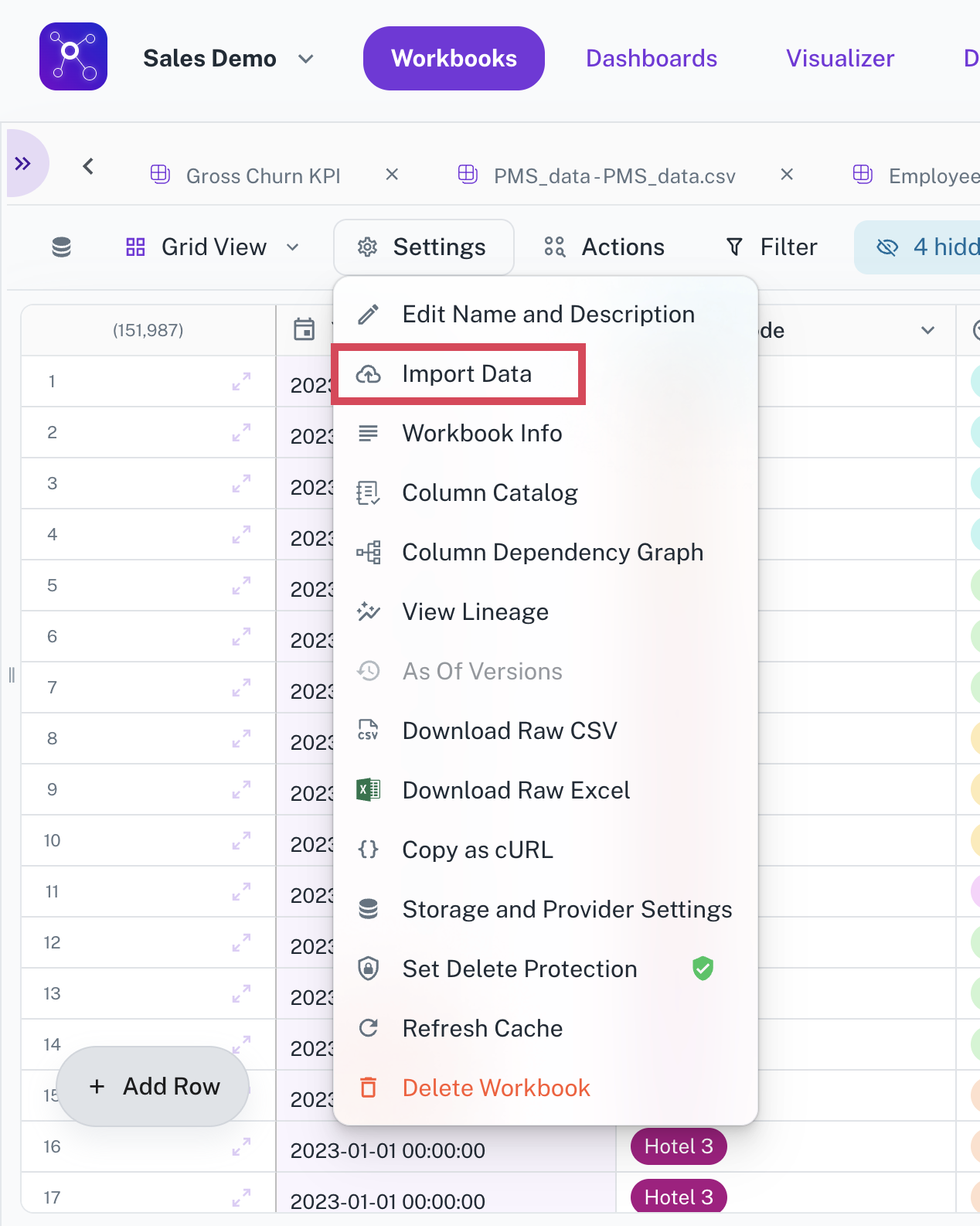
In a workbook, click Settings from the top and select Import Data.
-
In the Import dialog box, specify the type of file you want to upload and upload the file.

-
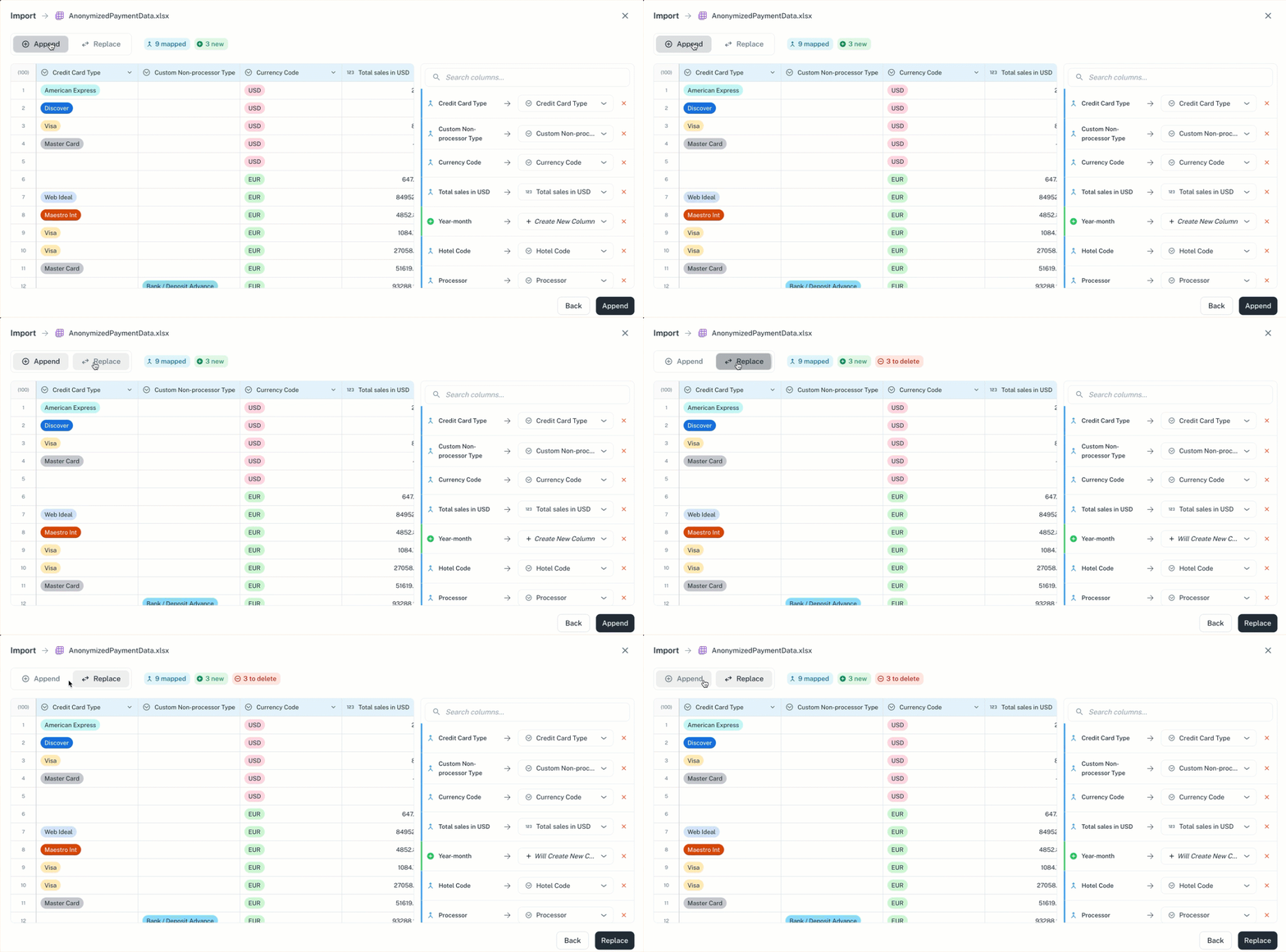
In the Import dialog box, specify whether you want to append or replace by clicking the corresponding buttons. Here, you can also modify the column mapping.
-
Click Append/Replace.
What's New
Links & Joins — Comma-Separated Multi-Value Matching on Import
Previously, importing data into a workbook with a lookup column only matched the first value in a cell — any additional comma-separated values were silently dropped, and if no exact match was found, the cell was left blank. With this enhancement, the system now splits imported cell values by comma and matches each one individually against the linked workbook, populating all matched entries into the lookup column in a single cell.
The use case this solves:
Consider you have a People workbook and a Projects workbook where Projects has a lookup column linked to People. When you import a CSV into Projects where a cell contains multiple names (e.g. John Doe, Alice, Mark), the system now resolves each name against the People workbook and populates all matched entries — instead of only the first match.
How to use it:
- Set up a workbook with a link column pointing to another workbook (e.g. Projects → People).
- Go to Settings → Append and upload your import file.
- Map the import column to the lookup field and select the matching column in the linked workbook.
- On import, any comma-separated values in that column are each matched individually against the linked workbook.
- All matched entries are populated into the lookup cell — supporting one-to-many matches in a single row.
What stays the same:
- The lookup column type remains a string/text field — it is not converted to multi-select.
- Existing formulas and lookups built on top of this column continue to work as before.
Known limitations:
- Applies to data imported via the Append workflow — not to manual row entry.
- Only values that find an exact match in the linked workbook are populated; unmatched values are skipped.
Was this helpful?